
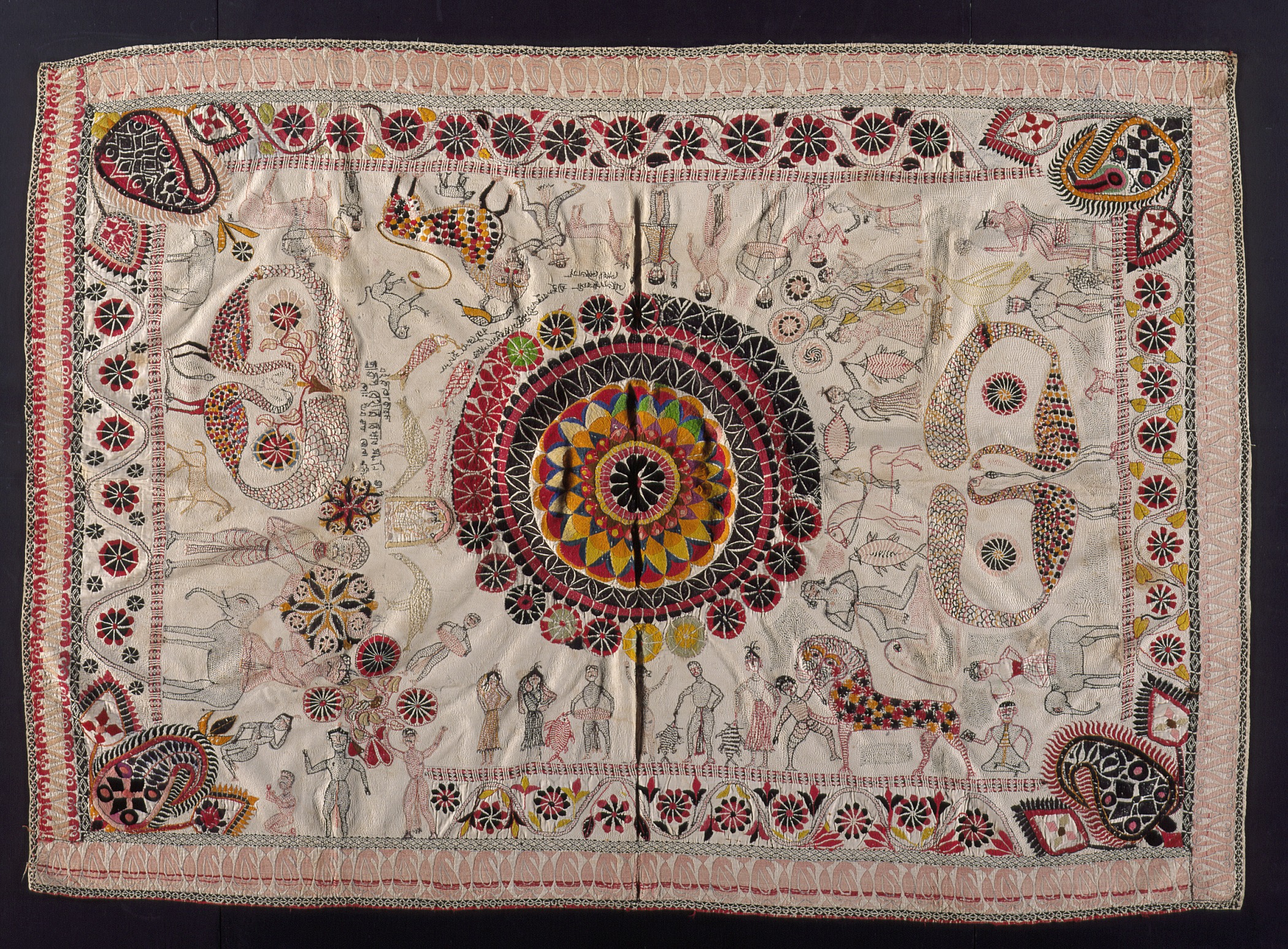
Originally made of worn-out saris, lungis or dhotis, the kanthas of Bengal had a functional, domestic use as coverlets, wrappings, pillow covers, ashons. However, they were occasionally embellished by floral motifs or even entire scenes drawn from rural life, myths, and folklore to give as gifts to loved ones – a daughter leaving home, a son getting married, a revered father. By writing Nakshi Kanthar Maath (1929), Jasim Uddin immortalised this women’s domestic art in poetry and gave the embroidered quilt the name that has become popular over the years.
In 1964, Tofail Ahmed, a collector of folk art, lamented that the kantha was “a lost art.” He noted that Jasim Uddin’s poem had become better known than the article itself and that, when the average Bengali spoke of the nakshi kantha or heard the term, it was the poem that was referred to or understood. With changing tastes and lifestyles, the popular craft of kantha was becoming a lost art. He believed that it would be in Jasim Uddin’s poem alone that the kantha would be preserved. “Drishtibhangi o paribartaner sange purba Pakistaner e gana shilpa lupta hoye jacche. Pallikabi Jasimuddiner ‘Naskshi Kanthar Maather’ bhitar diye amar thakbe e lupta shilper smriti.”
The kantha tradition, perhaps linked back to the embroidered quilts commissioned by the Portuguese from Satgaon, helped create some very fine kanthas in the regions of Jessore, Faridpur, and Khulna in the 19th century. Rajshahi and Kushtia also made kanthas, thicker and with fewer motifs. Notably, a kantha from Kushtia was given as a gift to Rabindranath Tagore, who lived in Shelaidaha between 1891 and 1901, and is preserved in Santiniketan.
Martha Alter Chen, an American working with BRAC, had been working with kanthas at the BRAC centre in Jamalpur. When a Japanese firm involved in the development of the hotel approached BRAC for a traditional design, Chen called upon Surayia Rahman, an artist who had earlier worked with WVA, to design a triptych kantha wall hanging. Drawing upon photos from the Stella Kramrisch Collection of the Philadelphia Museum of Art, Surayia Rahman designed a composite nakshi kantha. A sample kantha was made. BRAC, however, was unable to take up the work for the larger piece. As a result, Kumudini, which also had been working with kanthas, finally did the work on the larger piece. Apart from Surayia Rahman, Razia Quader also designed two pieces for the hotel: one replicated different forms of the lotus motif down its length, the other was a marriage scene which used the basic running stitch, but a stylised parallel form. Both this second kantha and Suraiya Rahman’s have influenced later kantha-making in Bangladesh. These pieces were very different from the functional kanthas as well as from the traditional kanthas in that they were made from new cloth and were designed to be viewed frontally rather than from the top as in traditional pieces. And in making these pieces – and training women to do the embroidery – the kantha was revived and made new again. However, even as the revival of the kantha was made possible by these pieces, the kantha was also changed by them.
Sister Michael Francis, or Sister Mike as she was generally called, an American nun of the order of the Holy Cross, had left the college to work in craft organisations. She was working with Kumudini at the time and offered to teach the Kumudini workers the needlework skills that they would need in order to complete the work. She helped needlewomen hone their traditional needlework skills, but also taught them a stitch to fill in large expanses of colour. Locally called the Kashmiri stitch or bhorat – which simply means filling – it is what is known in the western repertoire of embroidery stitches as the Romanian stitch. In traditional kanthas, large expanses of colour are filled by a variety of kantha stitches: the simple running stitch, darning stitches, pindot stitches, kaitya, or chatai. The use of traditional kantha stitches produces a muted effect. The Romanian stitch creates large expanses of colour. Surayia Rahman’s piece was embroidered using the bhorat. Instead of using the kantha stitch for the background, the empty spaces between the motifs were filled in with the darning stitch which eliminates the ripple effect of the traditional kantha running stitch.
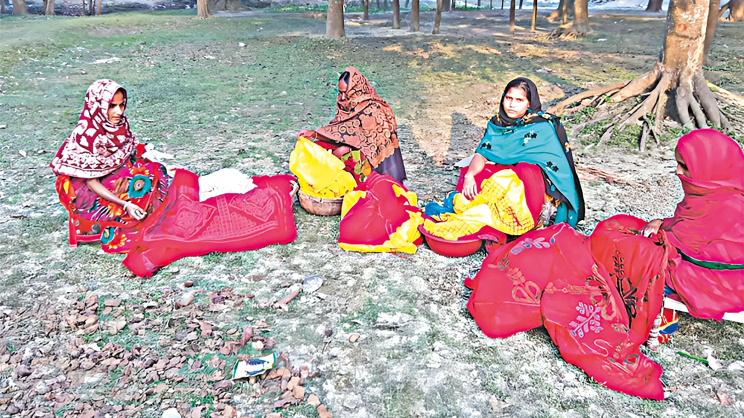
Sister Mike also made significant changes in Razia’s piece. Razia had planned that it would be worked in traditional kantha stitches, and designed feathery and light stitches to suggest the type of stitches to be used. However, Sister Mike substituted Razia’s suggested stitches with the chatai. Kanthas made at Banchte Shekha and Banchte Shekha Hasta Shilpa in Jessore use this stitch exclusively for their work.
The journey of the kantha from a simple layered coverlet to a work of art has not been smooth. On the way it absorbed external influences, looked at a changing world, and, in the process, changed the way we use or look at it.
Discussion